Engineering & Product Development
Rotary Egg Defect Detecting System
May – July 2026
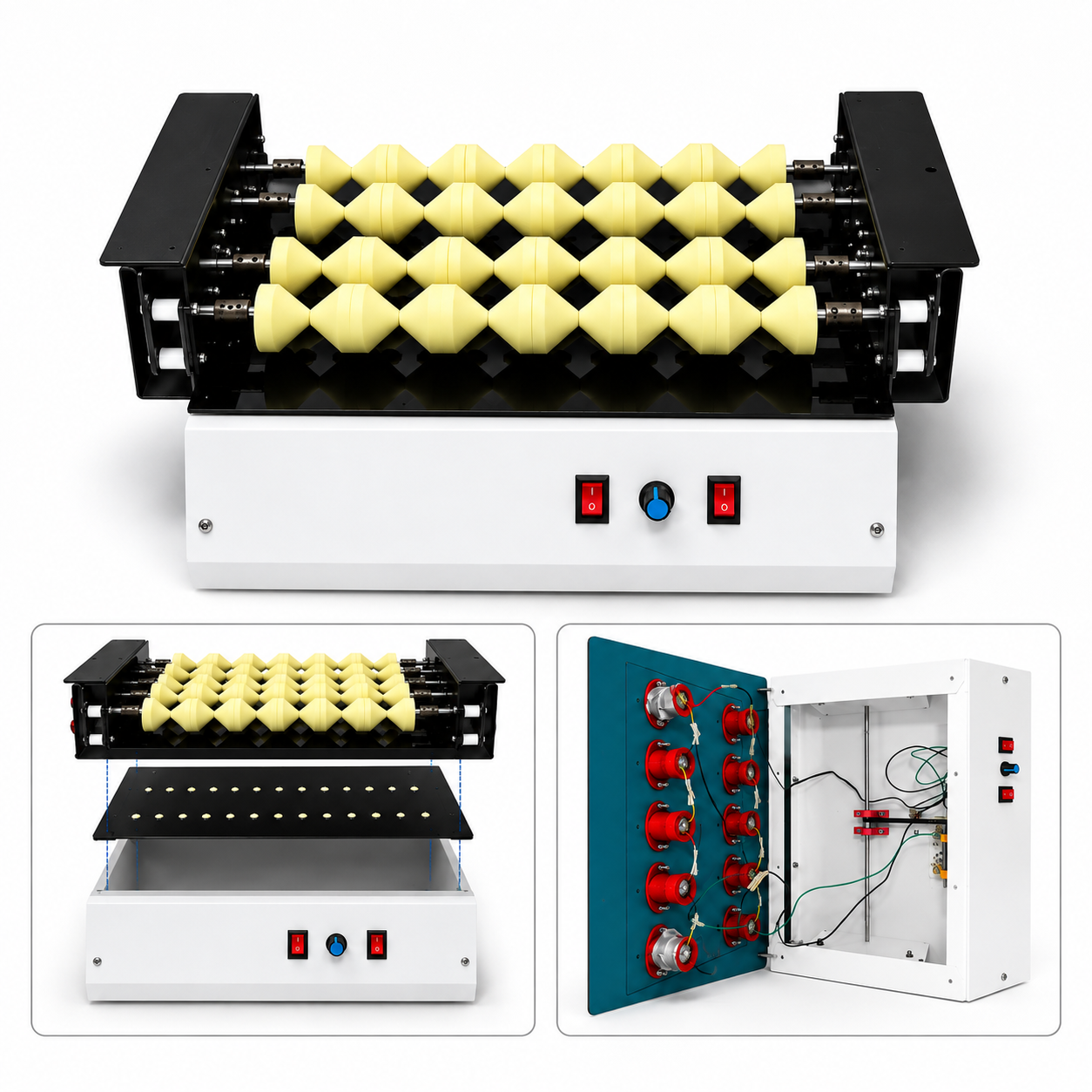
Automated rotating candling system for inspecting eggs at scale
During my internship at MakerWorks Lab in Mumbai, I worked with engineer and mentor Abhay Waghmare, an IIT alumnus, to design and prototype an automated system for inspecting eggs for internal and shell defects at commercial scale. Traditional candling allows an operator to illuminate and inspect eggs individually, which becomes slow and labour-intensive when large batches must be checked. Our goal was to create a system that could illuminate and continuously rotate multiple eggs simultaneously, exposing each egg from different orientations so defects could be identified more efficiently. We developed the machine as a modular, layered assembly. The bottom enclosure housed the motors, wiring, switches, and power electronics inside a fabricated sheet-metal chassis. Above it, I helped wire and solder an array of LEDs connected in parallel beneath an acrylic plate, creating uniform upward illumination across the inspection area. A removable upper tray held rows of custom 3D-printed rollers covered with silicone to increase friction while protecting the eggs and improving rotational control. A major engineering challenge was achieving reliable multi-axis egg rotation. Because eggs are asymmetric rather than perfectly spherical, roller spacing, diameter, profile, contact angle, and rotational speed all influenced whether they rolled smoothly. We repeatedly prototyped different roller geometries and spacing configurations until the eggs could rotate through multiple orientations without slipping or becoming trapped. The illumination acts as a candling system: light transmitted through the shell can reveal abnormalities such as cracks, blood spots, unusual internal shadows, yolk displacement, air-cell irregularities, or other changes in internal structure. Continuous rotation increases the observable surface and internal volume compared with inspecting a stationary egg. The removable roller tray also separated the eggs from the electronics, allowing entire batches to be loaded or replaced quickly while reducing the risk of liquid damaging the circuitry if an egg broke. **Skills developed:** mechanical design, CAD, sheet-metal fabrication, 3D printing, roller and friction mechanics, soldering, parallel circuits, motor integration, rapid prototyping, design iteration, system integration, and design for maintainability.